|
|
A Living Legend |
A Chronology of Cape Town’s Most Iconic Hotel
1743: The land upon which Mount Nelson Hotel is now situated was granted to Baron Pieter Van Rheede van Oudtshoorn. This land was known as ‘Oudtshoorn Gardens’ (at this time, the term ‘garden’ was used to describe a small farm). Baron Pieter returned to Holland and while he was there, he was appointed the new governor of the Cape. Unfortunately, he died en route back to Cape Town, and Oudtshoorn Gardens was subsequently subdivided and sold. (Number 10 Hof Street at the top of Government Avenue contains traces of Baron Pieter’s original home).
Fast fact: When people died aboard a ship, they were buried at sea, but Baron Pieter van Rheede van Oudtshoorn was kept in a lead lined coffin and preserved in brandy for four months until his ship reached Cape Town. He was buried with pomp and ceremony, and his tombstone can now be seen on the outer wall Cape Town’s Groote Kerk. |
|
 |
| |
Fast fact: There is a mysterious tale of the grave robbery of William van Rheede van Oudtshoorn. He was buried on his farm which bordered the Mount Nelson estate in 1822, in a very smart burial chamber (near the corner of present day Wilkinson and Faure Street). Along with his coffin, a desk, a chair, stationery and a silver inkpot (which was to be filled regularly) were locked in the chamber. 100 years later, the dilapidated vault split open, revealing three coffins – but the desk, chair and stationery had mysteriously vanished. The burial chamber has since been rebuilt.
1795: Dominee Fleck of Cape Town’s Dutch Reformed Church purchased the main house on the central strip of land on the property upon which Mount Nelson Hotel is now located.
1805: Lord Horatio Nelson died at the Battle of Trafalgar (he is said to have visited Simonstown at age 15 aboard the Seahorse, and at age 18 he is said to have returned to Simonstown aboard HMS Dolphin). |
|
 |
| |
1806: The property was let to an auctioneer - Mr William Maude. It is said that during this time, auctions of slaves and prized Arabian stallions took place on the property. On 3 August 1806 the property was advertised in The South African Gazette as ‘Mount Nelson’ – taking inspiration from Cape Town’s ‘Table Mountain’ and the ubiquitous ‘Lord Nelson’.
1843: Sir Hamilton Ross purchased the property. It was to remain within the Ross family for many years during which a beautiful garden was established, complete with deer and regal fountains. (Sir Hamilton is said to have been a passionate gardener, and Mount Nelson was known as one of the most magnificent gardens in Cape Town). Fact fact: When Mount Nelson was still the private home of the Ross family, the low wall in Orange Street (which has since been rebuilt) was used as a convenient resting place for washerwomen on their way to the municipal wash houses below Table Mountain’s Platteklip Gorge. The two lions on the property as well as a few ornamental pot plants and the iron boundary railing on Orange Street are all that remain of the Ross family homestead today. |
|
 |
| |
Fast fact: Hamilton Ross died at Sans Souci (a homestead located in what is now Cape Town’s Southern Suburbs) in February 1853 and his tombstone can now be seen in the Crypt of St George’s Cathedral.
Fast fact: In the 1870’s John Ross’s three eldest sons (Hamilton, John Junior and William) unearthed a heavy iron-bound chest. Their father thought it was a coffin and ordered them to bury it immediately. 25 years later, the only surviving brother tried to locate it, and had to conclude that it was under the laundry (designed by Sir Herbert Baker and built in 1899). So began the legend of Mount Nelson Hotel’s buried treasure…
1890: The Mount Nelson property was purchased by shipping magnate Sir Donald Currie, owner of the Castle Shipping Line. It was his dream to build a hotel in Cape Town as stylish and elegant as London’s most fashionable hotels, to cater exclusively for the Castle Line’s well-heeled First Class passengers.
1892: The Cape Town municipality assumes responsibility for The Company’s Garden – located across Orange Street, in the heart of the city centre - and declares the site open to the public. |
|
 |
| |
Fast fact: The Company’s Garden is South Africa’s oldest public garden. It was established by Dutch settlers in 1652. By 1679, the gardens had been transformed through a system of canals and boasted herbs and medicinal plants, fruit and vegetables, oaks, pines and roses.
Fast fact: Today the Company’s Garden is a popular site to visit, surrounded by important landmarks the likes of the Slave Lodge, the Houses of Parliament, the National Gallery, the Great Synagogue, the Holocaust Museum, St George’s Cathedral, the Iziko SA Museum and the Planetarium. Over the past few years, old buildings have been renovated, and new paving, additional lighting, improved security and landscaping have been introduced.
1899: Mount Nelson Hotel opens on Monday 6 March. The first hotel in South Africa to offer hot and cold running water, it received rave reviews and was applauded for being ‘even better than its London counterparts’.
Quotation from the hotel’s first advertisement in the Cape Times newspaper, 3 March 1899: “This large and splendid hotel, beautifully situated in the Gardens at the Top of Government Avenue, in the most Airy and Healthy part of Cape Town, offers to Visitors all the comforts of a First-class Hotel at Reasonable Charges”
|
|
 |
| |
October 12 1899: The South African War begins. The British used Mount Nelson Hotel as a headquarters from which to plan their military campaign. Lords Roberts, Kitchener and Buller were familiar figures in the hotel corridors, and a young war correspondent based at the hotel – Winston Churchill - described the hotel as: “…a most excellent and well appointed establishment which may be thoroughly appreciated after a sea voyage”.
Fast fact: If a British soldier residing at Mount Nelson Hotel during the South African War, behaved irresponsibly, he would be sent to work in the military horse stables at Stellenbosch, a town on in the outlying Cape Winelands area. The word ‘Stellenbosch’ subsequently found its way into the Oxford Dictionary as a passive verb meaning ‘to be relegated, as the result of incompetence, to a position in which little harm can be done’. |
|
 |
| |
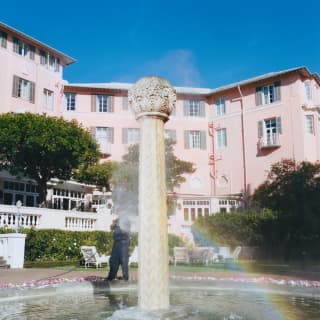
Fast fact: On Christmas morning in 1901, a British journalist, Hardwicke Foster Stanford, gate crashed a private officers’ party at the hotel. After bring subjected to a mock trial, he was tarred and feathered, and tipped into the hotel’s fountain. The incident was widely reported in the British press before it was brought to the attention of Lord Kitchener (after whom the central hotel fountain is named).Fast fact: The grandfather clock in the Hotel Lounge dates back to the early 1800’s. It is said to have struck midnight and chimed so loudly that it could be heard from Cape Town’s foreshore. One day an irate guest hammered two six inch nails into the chimes and for 20 years it remained silent, until a hotel guest offered to repair it. It still chimes at midnight, but not nearly as loudly.
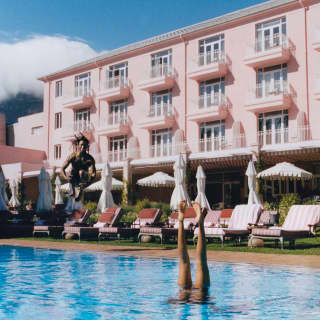
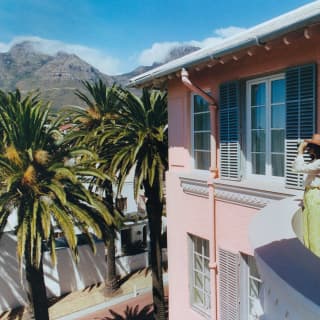
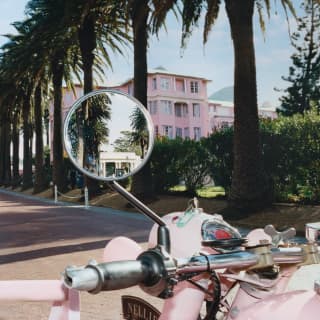
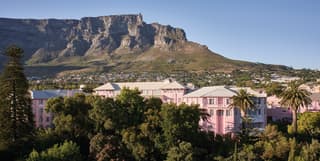
Fast fact: Mount Nelson Hotel’s second manager (an Italian by the name of Aldo Renato) celebrated the end of the First World War by decorating the hotel with a cheerful coat of pink paint. The trend towards pink hotels was popular throughout Europe for the next few decades, and so it was that Mount Nelson Hotel retained her pink blush, and is still known as ‘Cape Town’s famous pink hotel’. A definitive ‘Mount Nelson Pink’ has now been developed by paint experts who have formulated a shade calculated to fade to a specific colour between coats.
|
|
 |
| |
Fast fact: In 1919 Cape Town was ravaged by a deadly influenza virus. The city’s medical doctors designated Mount Nelson Hotel a ‘plague-free zone’.
1925: The Prince of Wales visited the hotel (the imposing ‘Prince of Wales Gate’ and palm-lined driveway was built the year before, in honour of this visit).
Fast fact: Sir Arthur Conan Doyle (the creator of Sherlock Holmes), stayed at the hotel at the end of 1928. A keen spiritualist, he is said to have outraged other guests and the Cape Town public by holding seances in his hotel room.
1973: The Oasis accommodation wing was added to Mount Nelson Hotel’s main house.
1988: Mount Nelson Hotel was purchased by Orient-Express Hotels, Trains & Cruises. Established in 1976 by Founder and Director James B. Sherwood, Orient-Express Hotels (http://www.orient-express.com/) is a hotel and travel company focused on the luxury end of the leisure market with many iconic and highly acclaimed properties. Founded in 1976 when the company acquired the Hotel Cipriani in Venice, Orient-Express has grown to encompass 51 businesses, including 41 highly individual hotels across five continents, two restaurants, two river cruise operations and six tourist trains, including the fabled Venice Simplon-Orient-Express which operates through Europe, linking London, Paris and Venice. Orient-Express chooses to own or part-own and manage its businesses, and continues to seek out unique properties with expansion potential and to introduce new experiences, restoring romance, glamour and style to international travel.Fast fact: Mount Nelson Hotel has always been a favourite with high profile politicians, authors and entertainers the world over. Famous faces spotted at the hotel over the years include: HRH Prince and Princess Michael of Kent, Agatha Christie, Marlene Dietrich, Robert Wagner, Shirley Bassey, Henry Kissinger, Simon and Yasmin le Bon, Donald Sutherland, Al Gore, Liberace, Joanna Lumley, Nicholas Cage, Hilary Swank, Lenny Krawitz, Phil Collins, Ethan Hawke, David Bowie and Iman, Janet Jackson, Sir Bob Geldof, Margaret Thatcher, George Bush Senior, HRH Prince Andrew, Jane Seymour, U2 and Bono, M Night Shayamalan, Mary J. Blige, Billy Joel, Alexander McCall Smith, John Malkovich, Paris Hilton, Maira Nair, Nelson Mandela, Charlize Theron, Oprah Winfrey, Colin Farrell, the Dalai Lama, Leonardo di Caprio, Richard Gere, Michael Buble, Robbie Williams and Morgan Freeman.
Fast fact: A few months before his untimely death John Lennon stayed at Mount Nelson Hotel under the pseudonym ‘Mr Greenwood’. He is said to have been exceptionally tidy (he even made his own bed), he meditated on Table Mountain, spoke to his wife Yoko Ono regularly, and planned to bring her to stay at the hotel the following year.
Fast fact: Legendary writer and explorer Sir Laurens Van Der Post wrote: “The Mount Nelson is a trustee of all that centuries of the European connection at its best meant to South Africa”.
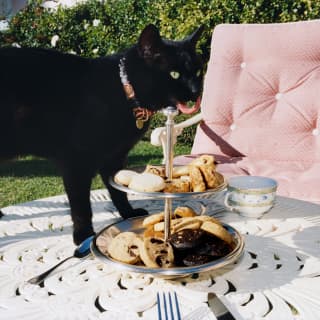
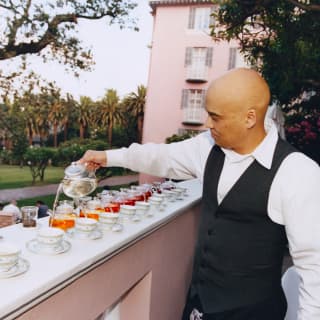
1989: Afternoon Tea is served on the Windsor Table in the Hotel Lounge on 1 November, for the first time ever (it had previously been served from an individual tea trolley).
1990: A row of eight perfectly restored historic cottages on the hotel grounds were converted into the elegantly appointed Garden Cottage Suites.
1993: An electrical fire causes extensive damage to the hotel, resulting in it having to be closed for six months, from June to December.
1996: Mount Nelson Hotel acquired three historic buildings adjacent to Palm Avenue, and Helmsley Hotel, and all four buildings were fully restored and converted into guest accommodation, increasing the total number of bedrooms and suites to 201. Taunton House Cottage was originally built as a guest house, Green Park was originally a hostel for nursing staff, and Hof Villa was built as a private residence for the hotel manager. Helmsley was originally the site of the first Jewish service in Cape Town (held in 1841) and thereafter it became the first Hebrew Congregation in South Africa.
Fast fact: In 1999 His Holiness the 14th Dalai Lama addressed over 500 Capetonians in the Mount Nelson Hotel ballroom. He enlightened his guests (who sat cross-legged on the ballroom floor) with a teaching on ‘The Four Noble Truths’ – and it is said that at mealtimes he would only request his two all-time favourite treats – crispy fried chicken and ice-cream.2003: Cape Town’s most glamourous bar, Planet Champagne and Cocktail Bar, opens in October. It is still the city’s favourite celeb-spotting hotspot, and its signature cocktails like ‘Planet Passion’ are legendary.
2006: The hotel’s fine-dining restaurant, Cape Colony, opens on 1 August.
2008: Librisa Spa – an elegant destination day spa – opens in April. The spa is owned and run by the hotel and has quickly established itself as one of the country’s leading spas, offering distinctive treatments in a magnificent setting.
2008: Mount Nelson Hotel is voted ‘Africa’s Leading Hotel’ at the World Travel Awards, and ‘Best Hotel in Africa’ by the Daily Telegraph’s Ultratravel One Hundred Awards. The hotel continues to attract the world’s most discerning travellers with its exceptional service, range of facilities and convenient location within the heart of Cape Town’s cultural centre. Mount Nelson Hotel has also established itself as one of the city’s most socially conscious hotels by incorporating a series of environmentally savvy initiatives and receiving accreditation with The Heritage Environmental Rating Programme. The hotel has also been instrumental in helping to establish The Hotels Housing Trust – a charitable initiative which facilitates fundraising for the construction of homes in impoverished local communities.
|
|
 |
| |
| |
|
|
|